Empathy Maps: Understand users before the AI starts
The most expensive mistake in digital projects is not the bug, nor the budget overrun. It is building the wrong thing, cleanly and on time. A website that makes everyone internally proud and misses what users actually need. This exact mistake is getting more expensive, because it now happens faster.
AI produces text, layout variants and code in minutes today. That is a gift as long as the direction is right. If it is not, teams just build out the wrong path more efficiently. So before any project, an unfashionable, very human question pays off: do we actually know who we are building this for? Empathy maps are a simple tool for answering that question before the first budget is spent.
What an empathy map is
The empathy map comes from design thinking, originally from Dave Gray. It is a simple map for one question: how does a typical user experience their world, and where does our offering fit into it? At the centre sits a persona, a fictional but concrete person who makes a target group tangible. Around them lie four to six fields, each taking one perspective.
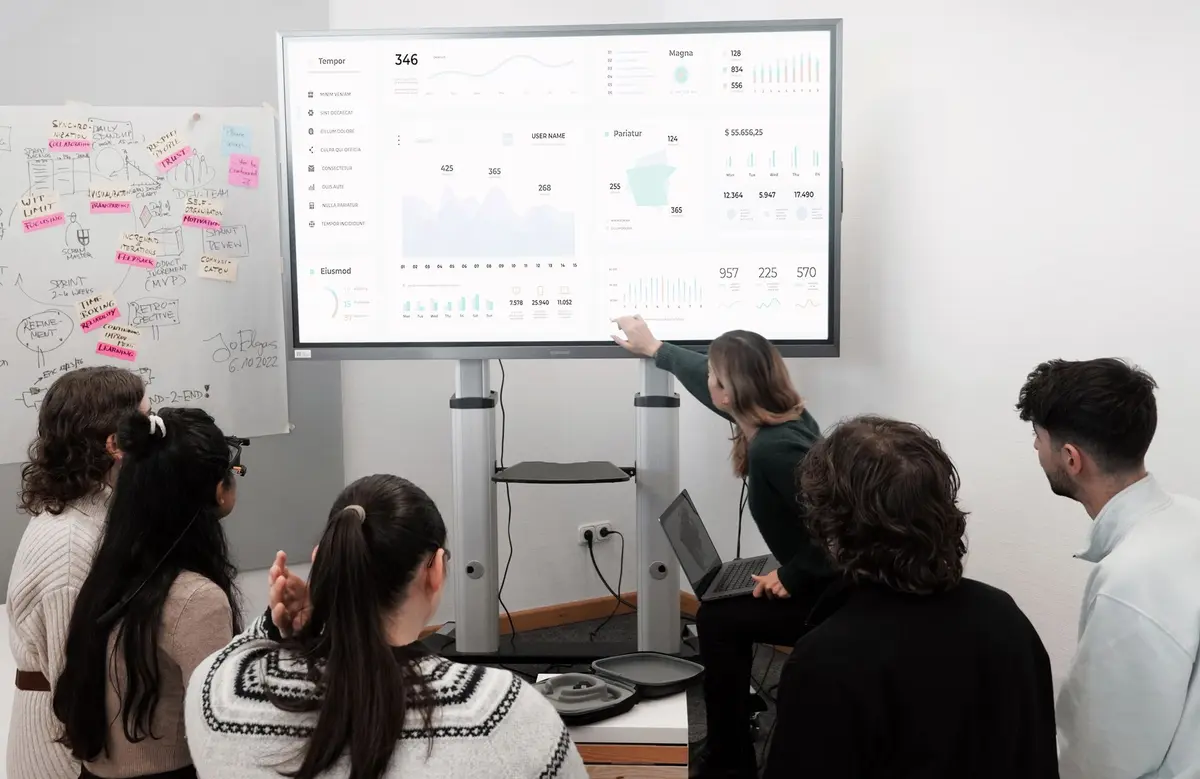
The tool is deliberately low-threshold. It needs no specialist knowledge, no software and no week of time, just a whiteboard, the right people in the room and an hour or two. This very simplicity is why it long ago found its way out of UX research into project and product management.
| Field | Guiding question | Why it matters |
|---|---|---|
| Think & feel | What really occupies this person, even unspoken? | Reveals motives never named in surveys |
| Hear | What do they hear from colleagues, bosses, the market? | Shows which voices shape the decision |
| See | What do they encounter daily, at competitors, in the inbox? | Places your offering in the real environment, not a vacuum |
| Say & do | How do they express themselves and behave, online and off? | Separates what people say from what they do |
| Pains | What frustrates, blocks, costs time? | Names the problems you must solve to be relevant |
| Gains | What would be a real win, a good outcome? | Makes measurable what the person defines success by |
A practical example: the purchasing manager who will not call
How this works shows in an anonymised example from one of our projects, typical in its course. A technical wholesaler wanted to relaunch its web shop. The internal assumption was clear: customers want more product photos and a more modern design. The team was ready to go, the budget allocated.
We invested two hours in an empathy map beforehand, with sales, internal service and two real customer conversations as the basis. The persona was a purchasing manager under time pressure. In the "Pains" field, what ended up was not "old design" but: cannot find the technical specification, has to call to clarify delivery dates, loses time with the login. The "Say & do" field showed that this customer orders at night and on weekends, exactly when nobody picks up the phone.
That turned the project around. A design relaunch became a project for findable data sheets, real-time delivery information and a faster checkout. The nicer photos came too, but as a side dish, not the core. A year later, the rate of phone inquiries for standard information had dropped noticeably, and the shop carried perceptibly more revenue. The two hours of empathy map were the most economical time in the whole project.
Why the tool matters more in the AI era
You might think AI makes such tools obsolete. After all, a language model can generate a persona and an entire empathy map at the push of a button. That is true, and this is exactly where the trap lies.
An AI-generated empathy map is an average of everything that was in the training data: plausible, smooth and without a single surprise. In the example above, it would have confirmed "modern design", because that is the expected answer. It would not have known the purchasing manager who orders at night and fails on the phone, because that detail came from a real conversation, not from the internet.
This is the division of labour that fits "Human Centered. AI First." (more in our guiding principle). Use AI to pre-structure the map, collect hypotheses and evaluate the minutes of customer conversations. But fill it with real observations. The cheaper production becomes, the more valuable the question of what should be produced at all. Empathy maps are one of the cheapest answers to it.
How to run an empathy map
You do not need a workshop professional, just discipline in five steps:
1. Get the right people. Sales and support belong in the room alongside marketing. They talk to customers daily and know the pains first-hand. 2. Pick one persona. One per map, concrete enough that everyone in the room pictures the same person. Better two maps for two clearly different target groups than one that means everyone. 3. Fill the fields, separated by evidence and assumption. What do we know from real conversations, and what are we only assuming? Assumptions are allowed, but must be marked as such. 4. Prioritise pains and gains. Not every pain point is equally important. Mark the two or three that decide success or failure. 5. Translate into requirements. Each prioritised pain becomes a concrete project requirement. Pains without an answer in the concept are the early warning that you are building past the user again.
The marked assumptions from step 3 are, by the way, your research plan: they tell you exactly what to talk about with real customers next.
What is the difference between a persona and an empathy map?
The persona is the person, the empathy map is the structured view of their world. In short: the persona answers "who", the empathy map answers "how does this person experience their daily life and our offering". In practice, a rough persona usually comes first and then the map around it.
Are analytics data not enough to understand users?
Analytics shows what users do, not why. You see that many abandon the checkout, but not that it is the forced account. Empathy maps and web analytics complement each other: the data shows where it sticks, the conversation and the map show why. Only both together carry a decision.
How often should we update an empathy map?
At project start and whenever the target group or the offering changes substantially. A map is not an archive document but a working tool. When new insights surface from support, sales or real tests, they belong in it.
Your next step
Before you start your next digital project, take the two hours. Get sales and support to a whiteboard, choose your most important target group and fill the six fields, honestly separated by evidence and assumption. If at the end a prioritised pain stands there without an answer in your project concept, you have just saved a lot of money.
If you want an experienced outside view along the way: we bring the tool into the Future Check and align your next project with real user needs together.
Go deeper in our knowledge base
Want to know what these topics mean for your company? The Future Check shows you the biggest levers within 2–4 weeks.