


Langdock: AI platform for businesses at a glance
Employees want to work with AI, and IT puts the brakes on, because accounts sold to private individuals come with no contract, and shadow AI on private accounts even less so. That is exactly the gap Langdock fills: it makes the major language models usable for the whole organisation, through one shared route instead of many individual ones.
This article describes what the platform does, what it costs, where the data sits and where its limits are. Prices, deployment models and contract clauses come from Langdock's own pages, retrieved on 7 August 2026, unless the sentence gives another date. Other sources are named in the sentence itself. How the category as a whole sorts itself out is covered in the article on AI platforms.
What Langdock is
Langdock is a piece of software through which all the staff of an organisation can work with the large AI models, and they do so through a shared company account rather than through private ones. The vendor does not train a model of its own. Instead the platform bundles the models of six providers into one interface: OpenAI (GPT), Anthropic (Claude), Google (Gemini), Meta (Llama), Mistral and DeepSeek. When a new model generation appears, it is available without switching platforms and is enabled by the administrators.
For the organisation that means one contract, one invoice, one user administration, and the choice of model stays open at all times.
The company behind it
- Registered office
- Berlin, Charlottenburg district court HRB 254499 B
- Founded
- 2023 by Lennard Schmidt, Jonas Beisswenger and Tobias Kemkes, with a place in the Y Combinator programme the same year
- Management
- since September 2026 with Judith Dada as co-CEO, announced in June 2026
- Funding
- 3.5 million USD documented
- Owner
- Langdock Inc., Delaware, see limits and risks
What Langdock does in daily work
Langdock takes over the tasks for which staff would otherwise open a private chat window. Sales pulls the requirements and the submission date out of a tender and has a proposal outline drafted, marketing puts a text into company wording and cuts it for several channels, support answers a recurring customer question from the company's own manuals and gets the passage cited alongside, and HR sorts the free-text answers of a staff survey by theme.
Each of these examples has a clear input and a clear form of result, and none of them appears on its own. A rollout rarely fails on the technology and usually fails because nobody names use cases like these.
Technically, five modules sit behind that: a chat with model choice and file upload, agents with their own knowledge base and actions through connectors or the Model Context Protocol, the knowledge function as a RAG system, integrations and an API.
What the workflow function is not
It orchestrates multi-step AI processing inside the platform, but it does not replace general automation software. The n8n directory lists roughly three times as many actions. More important than the count, though, is what starts a run in the first place: only eight applications fire on events in the other system, and for Google Sheets, Asana or monday.com the documentation points to a scheduled start. On top of that come one trigger per workflow, a limit of 2,000 steps per run and no documented automatic retries. Anyone wanting to connect line-of-business systems permanently therefore needs a different tool alongside it.
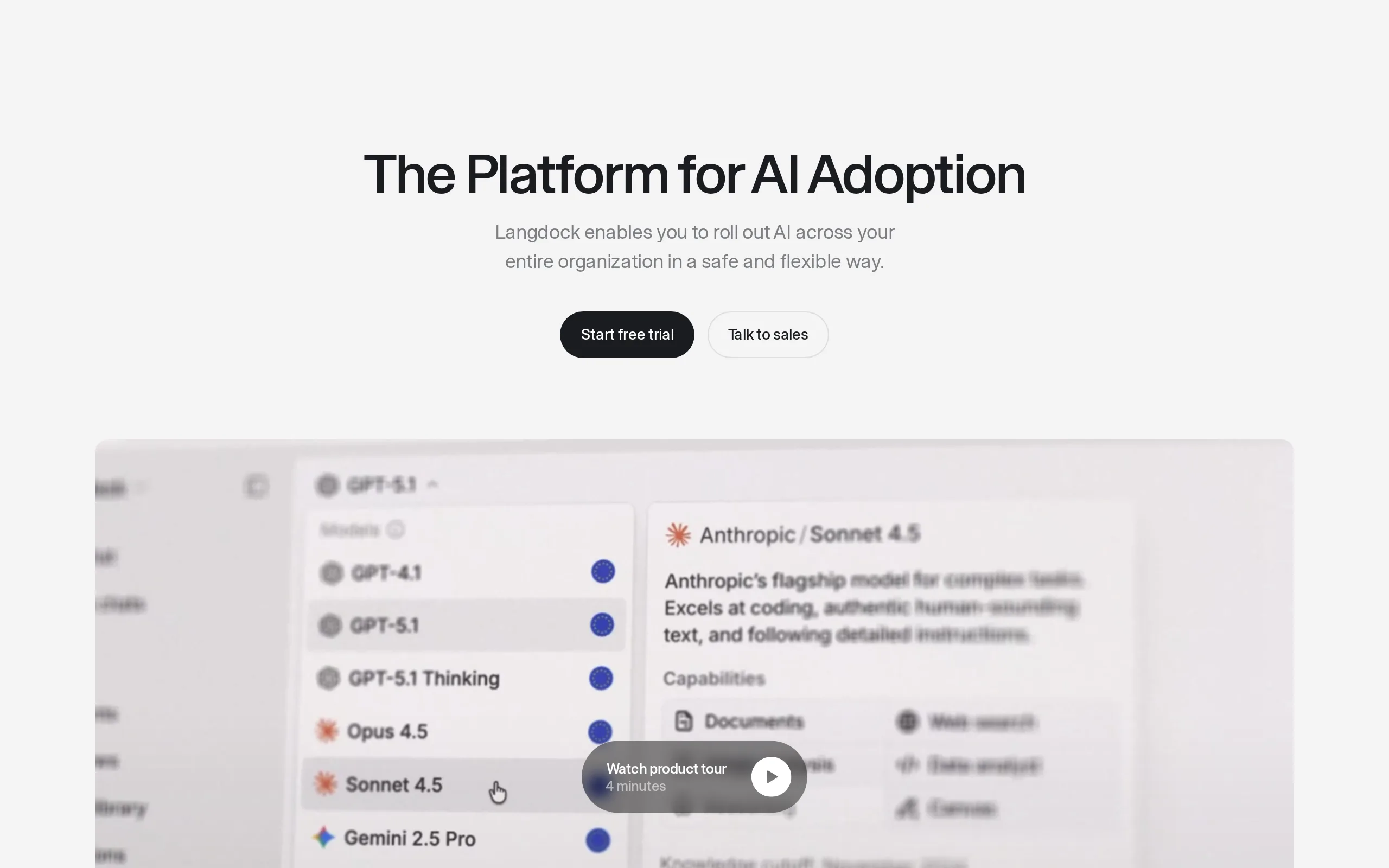
What that feels like in the interface is best shown by Langdock itself:

Langdock's own product overview (4 minutes, as of January 2026)
What Langdock costs
All figures are vendor statements. They stand here as factual information about the product, not as a recommendation and not as an arocom calculation.
| Plan | Price per user/month | Conditions |
|---|---|---|
| Trial | free | 7 days, no credit card, 5 EUR credit |
| Business Standard | 25.00 EUR plus VAT | up to 1,000 users, SSO and SCIM |
| Business Max | 99.00 EUR plus VAT | five times the allowance |
| Enterprise | individual | from 1,000 users |
On annual billing Langdock grants a 20% discount regardless of size. The billing documentation also lists four volume tiers (1 to 50, 51 to 250, 251 to 550 and above), though without the percentages that go with them.
Two add-ons come on top. Workflows are included with 2,500 runs, above that 40,000 runs cost 539 EUR and 100,000 runs 1,199 EUR per month, in each case per workspace and plus token costs. Governance is free until 1 January 2027 and costs 3.50 EUR per user per month after that.
Whether a seat price carries for your own organisation is decided less by the amount than by the question of how many employees regularly handle cases like the ones described above. That assessment belongs before the rollout, not after it.
Settle this before signing
Langdock caps model usage through several allowances: a five-hour session window, a weekly window that resets on Monday, a fallback model once the limit is reached, and 250 messages per three hours. How large the allowances per seat type are is not published. Individual Trustpilot reviews date these limits to 21 April 2026 and state that the change came without notice after they had signed. Anyone who depends on them therefore gets the allowances confirmed in writing beforehand.
Data privacy and the EU clause
By default all customers share the same environment and are separated only logically. It runs on Microsoft Azure with servers inside the EU, and the technical term for this is multi-tenant SaaS. Langdock names no specific city and no Azure region.
Customer data is not used for training, encryption is AES-256 and TLS 1.2+, and for administration there is SAML SSO, SCIM and audit logging. For the DPA addendum Langdock points to its trust centre. A subprocessor list naming the parties was not publicly retrievable there on 7 August 2026 and has to be requested. On certifications the exact wording is worth a look, because ISO 27001 is certified while SOC 2 Type II is audited.
Storage and processing are two different things
Two things need separating: where a file sits, and where the computing for a single request happens. For the second the terms use the word inference. Storage is phrased with a caveat: "The Customer's data is stored on servers located in the European Union, unless otherwise agreed." For data at rest the wording is tighter, even with global models it is "stored exclusively in Langdock's selected data centers within the EU". For the computing itself, however, globally deployed models fall under: "For these LLMs, the processing of prompts and responses for inference may take place worldwide, including outside the EU". So the sentence "all data stays in the EU" no longer holds once a workspace has enabled such a model. Anyone who needs that assurance disables those models and documents it in the pre-rollout review.
What "private cloud" requires
| Deployment model | Requirement |
|---|---|
| Multi-tenant SaaS | standard, no minimum size |
| Single-tenant SaaS | enterprise, from 2,000 seats |
| Bring your own cloud | enterprise, from 5,000 seats |
| On-premise | enterprise, from 5,000 seats |
For a mid-sized company that leaves only the multi-tenant setup in practice.
Limits and risks
Who owns the company
According to the shareholder list, Langdock GmbH is 100% owned by Langdock Inc. in Delaware, USA. Swiss lawyer Martin Steiger researched this in June 2026, and Business Insider and Sifted picked it up. For a startup out of the Y Combinator programme the structure is standard, and the contracting party remains the GmbH under German law. Steiger nonetheless sees an access risk under the US CLOUD Act, and whether its criteria apply here is legally disputed. This is an assessment, not legal advice.
How many models compute outside the EU
There is no reliable figure. Langdock puts the number at over 40 on its API page (retrieved 11 August 2026), while the models page itself carries no total. An outside count by gewusst-ki.de came to 35 listed models on 4 August 2026, seven of them without a fixed EU region. Anyone who wants a binding answer has to ask for one before signing. The frequently quoted claim of "hosting in Frankfurt", at any rate, appears on no Langdock page.
What the EU AI Act additionally requires
The governance add-on provides an agent inventory with an approval process and compliance rules, including a template for prohibited practices under Article 5 of the AI Act. Anyone using Langdock is thereby a deployer under Article 3(4) and must additionally ensure AI literacy under Article 4, binding since February 2025. No add-on settles that obligation; it takes training.
Who it does not pay off for
Langdock nowhere mentions special terms for associations, federations, foundations or educational institutions, so a charitable provider pays the same list price as an industrial company.
Below roughly ten seats, moving to a platform does not pay off, because individual licences are cheaper then and the administrative problem a platform solves does not yet exist at all with five people. That is our assessment, not a Langdock statement.
How long it takes before anything lands
A published 90-day field test puts the time to noticeable benefit at six to ten weeks and describes the introduction as "effectively a small IT project, not plug and play". Its author works in the HR software market himself, so the figure should be read accordingly. The review by Florian Gahn from May 2026 is predominantly positive in tone and still puts it most sharply: without accompanying enablement, in his words, the tool remains an expensive GPT frontend (German original, retrieved 11 August 2026).
Public reviews are of little help for an assessment: OMR Reviews lists none at all, G2 eight, Trustpilot nine at 2.3 out of 5 stars. With so few voices no average says anything.
When Langdock is worth it
Langdock fits when AI is to be rolled out as a working tool for many employees, with central control and GDPR requirements, but without an in-house development team. From around ten seats the platform solves a real administrative problem. The smaller the organisation, the more a clearly named first use case decides it and the less the user count does; Langdock itself names no lower bound.
It does not fit when a hard assurance of "no processing outside the EU" is required and the models in question are needed, or when genuine tenant isolation is demanded.
The effort sits less in the licence than in the admin configuration with its model approvals and in the use cases that first have to be worked out with the departments. Both belong in the rollout plan.
Roll out Langdock, or compare first?
arocom advises vendor-independently on AI platforms, supports Langdock rollouts, and integrates GPT, Claude, and co. directly into your systems. Write to us for an informal chat.
What is Langdock?
Langdock is an AI platform from Langdock GmbH in Berlin that bundles language models from six providers into one interface: chat, agents, a knowledge function, workflows, and an API.
What does Langdock cost?
On langdock.com the vendor states 25.00 EUR per user per month plus VAT for Business Standard and 99.00 EUR for Business Max, each 20% less with annual payment (retrieved 7 August 2026). Those are the vendor list prices; what a rollout costs on top depends on its scope and appears in no price list.
Does all data stay in the EU with Langdock?
Storage yes, processing not necessarily. The terms of service name EU data centres for data at rest, but allow the computing for a request to happen outside the EU for globally deployed models. EU-only processing requires those models to be disabled.
Is Langdock GDPR-compliant, and who owns the company?
Langdock provides a DPA, does not use customer data for training, and states that it is ISO 27001 certified and SOC 2 Type II audited. The contracting party is Langdock GmbH in Berlin; according to the shareholder list it is 100% owned by Langdock Inc. in Delaware. Whether that creates a CLOUD Act risk is legally disputed.
How many users does Langdock need to pay off?
Langdock names no minimum user count. Below roughly ten seats the administrative problem a platform solves does not yet exist. There is no upper limit; an environment for a single organisation, though, only starts at 2,000 seats.
How does AI & Automation hold up on your website? The Future Check shows where the biggest levers are — in 2–4 weeks.
Go deeper
Read next
Copy this prompt and paste it into ChatGPT, Claude, or another AI — you'll get a personal learning plan for „Langdock: features, pricing and limits at a glance“.
You are an experienced coach for AI & Automation. I want to understand the topic "Langdock: features, pricing and limits...Reviewing an AI platform
24 review questions across six axes, with a findings sheet. Vendor-neutral.
Was this article helpful?