


RAG Explained: AI Answers Based on Your Own Data
Your chatbot should answer customer questions, but using your information, not whatever the AI model picked up somewhere on the internet. That is exactly the problem Retrieval-Augmented Generation solves.
RAG is the most widely used architecture for enterprise AI applications in 2026. This is not because it is new (Meta AI introduced the concept in 2020), but because it addresses the central problem of Large Language Models: hallucinations.
How RAG Works: The Three Steps
RAG combines two AI disciplines: Information Retrieval (search) and Text Generation. The workflow:
Step 1, Indexing: Your content (website texts, PDFs, FAQs, product data) is split into text chunks and stored as vectors in a vector database. Each vector represents the meaning of a text passage.
Step 2, Retrieval: When a user asks a question, it is also converted into a vector. The vector database finds the most relevant text passages, typically the 3–10 best matches.
Step 3, Generation: The retrieved text passages are passed to an LLM like Claude or GPT along with the user question. The model generates an answer based on your own data, not on its general training.
The result: precise, source-based answers instead of generic AI text.
Why RAG Is Better Than Pure Prompting
An LLM without RAG has three structural problems:
Hallucinations: The model invents plausible-sounding answers when it does not know the right one. With RAG, it receives the correct information as context, and the hallucination rate drops measurably.
Outdated knowledge: LLMs have a knowledge cutoff. They do not know your product prices from last week. RAG accesses your current data.
No source citations: An LLM cannot say where its answer came from. A RAG system can deliver the sources, so every answer becomes verifiable.
Another advantage: RAG is significantly cheaper than fine-tuning. Instead of retraining the model with your data, you provide the relevant information at runtime.
RAG vs. Fine-Tuning: When to Use Which
RAG is suitable when: - Your data changes regularly (products, prices, news) - Source citations matter (compliance, customer support) - You want to start quickly (weeks instead of months) - Budget is limited (no GPU cluster needed for training)
Fine-tuning is suitable when: - The model needs to learn a specific style or tone - The task is highly specialized (e.g. medical texts) - Performance on recurring tasks needs to be maximized
In practice, many companies combine both: A fine-tuned model with RAG access to current data. arocom advises on the right strategy based on your specific use case.
RAG in Practice: Three Use Cases
Intelligent website search: Users ask questions in natural language. The RAG system searches your content semantically and delivers a summarized answer with links to the source pages. At arocom, we implement this for Drupal platforms, where your content becomes the knowledge base.
AI-powered customer support: A chatbot that answers from your FAQs, manuals, and support documents. Every answer includes the source, so support staff and customers can verify the information.
Internal knowledge assistant: Employees query the system about processes, policies, or product details. RAG searches your intranet, wiki, and document archive and delivers context-aware answers.
A recommended introduction:
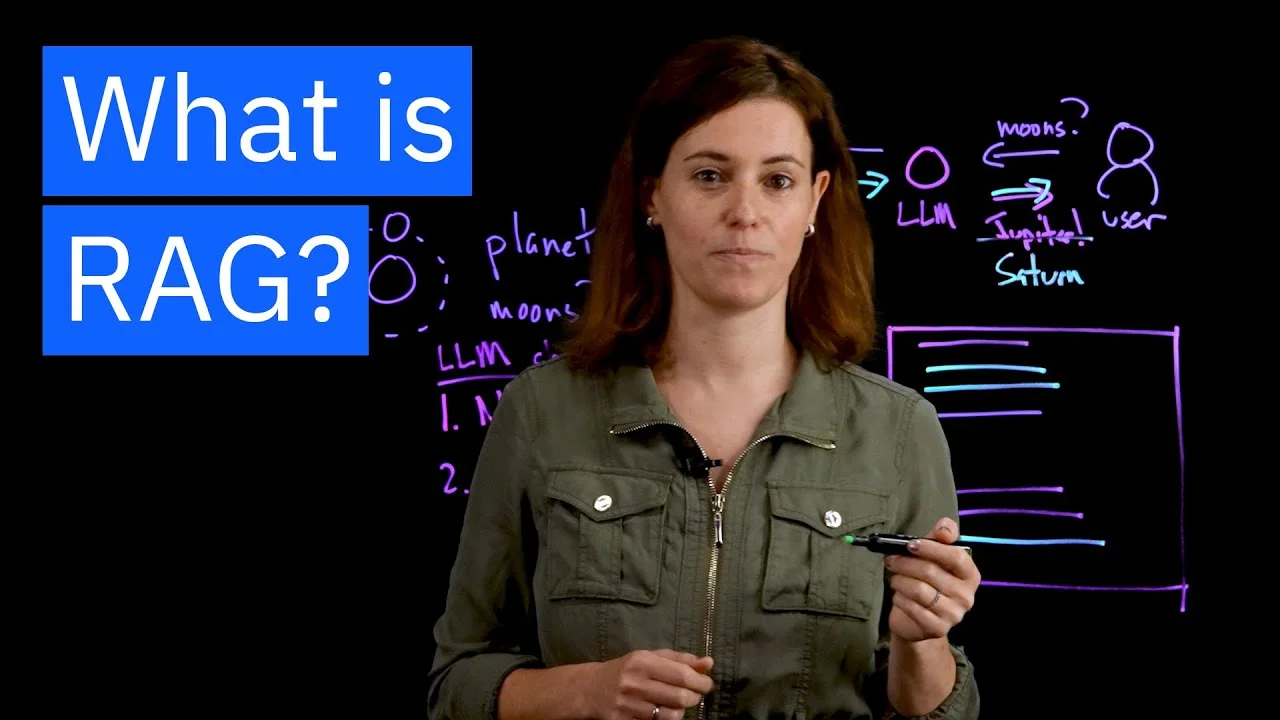
What is Retrieval-Augmented Generation (RAG)?: IBM Technology
RAG Tech Stack: What You Need
A RAG system consists of four components:
1. Embedding model: Converts text into vectors. Options: OpenAI Ada, Cohere Embed, open-source models like BGE or E5.
2. Vector database: Stores and searches the vectors. For Drupal projects, arocom recommends pgvector (integrated into PostgreSQL) as a starting point. More: Vector databases explained.
3. LLM: Generates the answer. Claude, GPT-4o, or open-source models like Llama.
4. Orchestration: Connects the components. Frameworks like LangChain or LlamaIndex simplify the setup. For AI Agents, the Model Context Protocol (MCP) is increasingly used as a standard protocol.
RAG for Your Drupal Platform?
Whether intelligent search, chatbot, or knowledge assistant: arocom plans and implements RAG architectures. Get in touch for a no-obligation consultation.
Request RAG consultationWhat is RAG (Retrieval-Augmented Generation)?
RAG is an AI architecture that connects Large Language Models with external knowledge sources. Instead of relying only on training data, a RAG system searches your own documents and generates answers based on those sources. This reduces hallucinations and makes answers verifiable.
When do I need RAG?
Whenever an AI system should work with your own, current data, for example website search, customer support chatbots, or internal knowledge assistants. If generic AI answers are sufficient, RAG is not necessary.
What is the difference between RAG and fine-tuning?
RAG provides the model with relevant information at runtime as context. Fine-tuning retrains the model with your data. RAG is faster, cheaper, and keeps data current. Fine-tuning is suited for specialized tasks and style adaptation.
Which data sources can RAG use?
Virtually all text-based sources: website content, PDFs, Word documents, FAQs, databases, wikis, support tickets. The content is indexed once and is then available for queries.
How much does a RAG implementation cost?
Running costs consist of API costs for the LLM (a few cents per query) and hosting the vector database. The main investment is in initial design and integration. arocom advises on realistic total cost estimates.
Can RAG completely prevent hallucinations?
No, but it significantly reduces them. RAG gives the model the right information as context. If the answer is not in the sources, the model may still speculate. That is why every RAG implementation needs a quality assurance layer.
Further Reading
- Vector Databases Explained: The infrastructure behind RAG
- Large Language Models: The models that power RAG
- Claude: Anthropic's AI Model: An LLM for RAG architectures
- AI Agents: Autonomous systems that use RAG
- MCP: Model Context Protocol: The standard for AI data access
- Generative AI for Business: The big picture
- AI Integration as a Service: What arocom delivers
External Resources
- RAG Paper (Lewis et al., 2020): The original paper by Meta AI
- LangChain RAG Documentation: Framework for RAG pipelines
- LlamaIndex: Framework specialized for RAG
- What is RAG? (IBM Technology, YouTube): Visually explained in 7 minutes
How does AI & Automation hold up on your website? The Future Check shows where the biggest levers are — in 2–4 weeks.
Go deeper
Read next
Copy this prompt and paste it into ChatGPT, Claude, or another AI — you'll get a personal learning plan for „RAG Explained: Retrieval-Augmented Generation for Business“.
You are an experienced coach for AI & Automation. I want to understand the topic "RAG Explained: Retrieval-Augmented Gen...Reviewing an AI platform
24 review questions across six axes, with a findings sheet. Vendor-neutral.
Was this article helpful?